
Boules has a wonderfully simple aim: get your ball closer to the small target ball than your opponent.
That’s the easy part.
The trouble begins when somebody blocks your route, knocks your best ball away or lands their final attempt a few centimetres closer than yours.
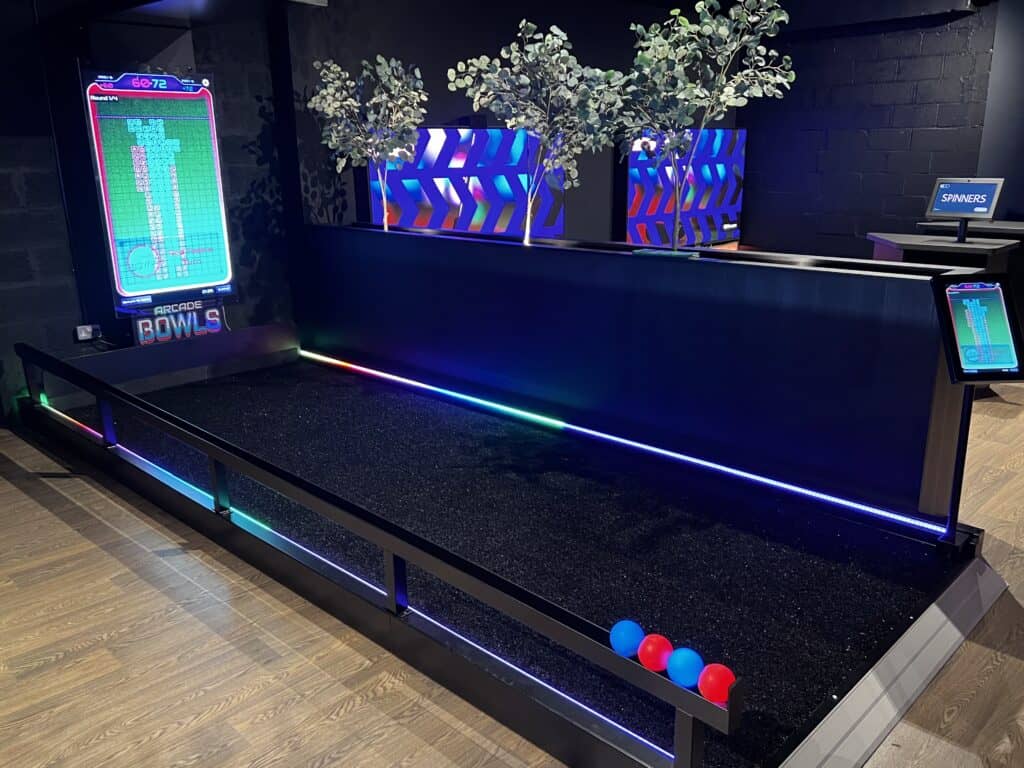
Traditional boules is often associated with sunny French squares and leisurely afternoons. At Spinners, it’s been given a rather brighter update. LED balls, a glowing target, smart tracking and automatic scoring transform it into a fast, indoor group game.
You don’t need any previous experience or specialist technique. Choose your game, roll your ball and let the system handle the scoring.
This guide explains how traditional boules works, how the scoring is calculated and what you can do to improve your chances of winning.
What Is Boules?
Boules is a family of games in which players throw or roll balls towards a smaller target ball.
The word comes from the French term for ball. Several different games sit under the boules umbrella, including pétanque, boule lyonnaise and similar regional versions.
Although the exact rules vary, they share the same basic idea. One player sends out a small target ball, traditionally called the jack or cochonnet. The players then take turns trying to place their larger balls as close to it as possible.
You can aim for an empty space, block an opponent’s route or knock another ball away from the target.
Once all the balls have been played, the player or team closest to the jack scores.
Electric Boules at Spinners keeps the accessible, tactical nature of the original game while adding glowing equipment, interactive screens, smart ball tracking and automatic scoring.
How Do You Play Boules?
Boules can be played one-on-one or in teams.
Traditional rules vary depending on the version being played, but a typical round works like this:
-
- Divide the players into two sides.
-
- Choose which team will play first.
-
- Place or throw the small target ball into the playing area.
-
- The first player sends a boule towards the target.
-
- A player from the opposing team takes their turn.
-
- Continue until all the boules have been played.
-
- Check which team has finished closest to the target.
-
- Award the points and begin another round.
The game continues until a player or team reaches the agreed winning score.
In traditional pétanque, games are commonly played to 13 points. Other versions may use a different target or play for a fixed number of rounds.
At Spinners, the touchscreen explains the chosen game and keeps the action moving. You don’t need to bring equipment, mark scores on paper or settle debates with a tape measure.
How Does Boules Scoring Work?
In a traditional game, points are awarded after every player has used all their boules.
Only one player or team scores in each round.
The side with the boule closest to the target receives one point. It can then earn another point for each additional boule that is closer than the opposing team’s nearest one.
For example, imagine that your team has the closest two boules. Your opponent’s best boule is the third closest.
Your team would score two points.
If your team has the closest boule but your opponent has the second closest, you receive one point.
This scoring system makes every ball important. You may have three strong positions, only for an opponent’s final shot to roll closer or knock your best boule out of the way.
The scores are added after each round until one side reaches the winning total.
With Electric Boules at Spinners, smart tracking detects the balls and the system handles the scoring for you.
What Is the Small Ball Called in Boules?
The small target ball is usually called the jack.
In French pétanque, it’s known as the cochonnet, which translates literally as “piglet”. You may also hear people call it the target ball.
Players aim to finish as close to the jack as possible. Its position defines the focus of the whole round.
Traditional games begin with one player throwing the jack into the playing area. In Electric Boules, the glowing jack and interactive system make the target easy to see throughout the game.
What Is Electric Boules?
Electric Boules is a modern, technology-powered version of the traditional game.
Players use LED-lit balls on a glowing indoor court. Smart tracking follows the action, while interactive touchscreens explain the game and record the scores.
At Spinners, there are three Electric Boules game modes:
-
- Classic
- Turf Wars
- Battle Bowls
- Bowls Eye
Each mode offers a different version of the challenge. The screen guides players through the rules before and during the game, so you don’t need to learn everything in advance. -
-
- Date nights
-
- Birthday celebrations
-
- Family outings
-
- Work socials
-
- Stag and hen groups
-
- Casual nights with friends
-
-
- Classic
-
- Turf Wars
-
- Bowls Eye
It keeps the best parts of traditional boules: accuracy, tactics and the pleasure of ruining an opponent’s excellent shot. The technology then removes the measuring and manual scoring.
Electric Boules vs Traditional Boules
Electric Boules is based on the same core skills as the outdoor game, but the setting and technology change the experience.
It’s played indoors
Traditional boules is normally played outdoors on gravel, sand or another firm surface.
Electric Boules is fully indoors. There’s no wind, rain or badly timed downpour to disrupt the game.
The equipment lights up
Traditional boules uses metal balls and a small wooden jack.
Electric Boules uses LED-lit balls and a glowing target. Dynamic lighting and neon graphics make it easy to follow the action.
The scoring is automatic
In a traditional game, players may need to compare positions or measure the distance between several boules and the jack.
Electric Boules uses smart tracking and automated scoring, so the system decides who has won the points.
There are different game modes
Traditional pétanque generally follows one established format.
Electric Boules offers Classic, Turf Wars and Bowls Eye, giving groups different ways to compete during the same session.
It’s designed for social play
You can learn the basics within minutes. The screen explains what to do, the system keeps score and turns move quickly.
That makes it well suited to date nights, birthdays, family outings and work socials.
How to Hold and Roll a Boule
Hold the ball comfortably in one hand with your fingers spread around it.
Keep your grip secure but relaxed. Squeezing too tightly can make the release feel stiff and affect the direction of the ball.
Face the target and keep your body balanced. Swing your arm smoothly backwards and then forwards, releasing the ball towards your chosen landing point.
Electric Boules is about control rather than force. You aren’t trying to send the ball to the far end of the building.
A smooth, measured roll is usually much easier to direct than a fast one.
Should You Aim at the Jack?
The jack is the obvious target, but aiming directly at it isn’t always the best move.
If the route is clear, rolling close to the jack can put immediate pressure on your opponent. However, the balls already in play may block the direct line.
You may be better off aiming slightly to one side, placing a defensive ball in front of the jack or attacking an opponent’s leading position.
Think about where your ball will finish, not just where you want it to travel.
A boule that stops slightly short can act as a useful blocker. One that passes the jack may still score if your opponent struggles with the distance.
Can You Knock an Opponent’s Ball Away?
Yes. Knocking an opponent’s ball away from the target is a key boules tactic.
You can aim directly at their leading ball and try to move it into a weaker position. A successful attacking shot can completely change the score.
You can also hit the jack. Moving the target may bring your other boules into scoring positions or take it away from your opponent’s best ball.
Attacking shots carry a risk. Miss the target and your ball may finish a long way from the action. Hit it at the wrong angle and you could improve your opponent’s position.
Sometimes a gentle placement shot is safer. Sometimes revenge is worth the gamble.
Pointing vs Shooting in Boules
Traditional boules tactics are often divided into two types of shot.
Pointing
Pointing means placing your boule as close to the jack as possible.
The aim is to control the speed and direction so the ball stops in a strong scoring position. A good pointer thinks about the route, the surface and the balls already in play.
Shooting
Shooting means aiming at another boule to knock it away.
This is the more attacking option. It can remove an opponent’s scoring ball or clear a route towards the jack.
You don’t need to specialise when playing socially. Most players will use a mixture of placement and attacking shots depending on the situation.
Seven Boules Tips to Help You Win
The rules are easy to understand, but a little thought can make a big difference to your score.
1. Learn the speed of the court
Use your opening turn to judge how quickly the ball travels.
Start with a controlled roll rather than using too much power. Watch how far it carries and whether it stays on a straight line.
You can adjust your next shot once you understand the pace.
2. Choose a landing point
Don’t focus only on the jack.
Pick a point on the court where you want the boule to land or pass. A closer target can make it easier to control the line and distance.
This is particularly helpful when you need to roll around another ball.
3. Use less force
Boules rewards control.
Rolling too hard may send your ball beyond the useful scoring area. Use a smooth movement and allow the ball to travel naturally.
It’s easier to add a little more power on your next turn than retrieve a ball that has raced past everything.
4. Build a defensive position
A boule doesn’t have to be the closest to remain useful.
Placing one directly in front of the jack can block an opponent’s route. They may need to take a wider line or use an attacking shot to remove it.
Your next boule can then be placed behind the blocker.
5. Watch every shot
Pay attention to how the other balls travel.
You can learn which routes are quick, how much force is needed and whether balls tend to move to one side.
Other players may also reveal a strong route to the target. There’s no reason not to use the information they’ve kindly provided.
6. Know when to attack
If your opponent already has several boules close to the jack, another cautious placement shot may not help.
An attacking roll could knock their leading boule away or move the jack into a better position for you.
Consider the score and how many balls remain before taking the risk.
7. Protect the lead
If your side already holds the closest position, you don’t always need to aim for an even better one.
Use your next shot to make your leading boule harder to reach. A carefully placed blocker can force your opponent into a difficult angle.
The prettiest shot doesn’t win the round. The closest ball does.
Common Boules Mistakes
Rolling too hard
New players often use far more power than they need.
A fast ball is harder to control and may travel beyond the scoring area. Focus on a smooth release and accurate distance.
Only watching the jack
The target is important, but so are all the other balls.
Look for blocked routes, possible rebounds and opportunities to remove an opponent’s strongest position.
Repeating the same shot
The court changes every time another ball is played.
A route that worked during your first turn may no longer be available. Check the whole playing area before each roll.
Attacking too early
Knocking balls away is satisfying, but it isn’t always necessary.
If the area around the jack remains open, placing a strong ball may be the safer option. Save the attacking shots for moments when your opponent has control.
Giving up after one poor roll
A weak opening shot doesn’t decide the round.
Your ball could become a blocker, be pushed forwards later or return to contention if the jack moves. Concentrate on the position in front of you.
Forgetting who is leading
Before taking your turn, check which ball is currently closest.
This will tell you whether you need to attack, defend or simply improve your position.
Is Boules the Same as Pétanque?
Pétanque is a type of boules.
“Boules” is the broad name for a family of ball games. Pétanque is one of the best-known versions and has its own formal rules.
In traditional pétanque, players throw metal balls from a marked circle while keeping their feet on the ground until the ball lands. The aim is to finish closer to the jack than the opposing team.
Other boules games may use a run-up, different equipment or different playing surfaces.
Electric Boules takes inspiration from this wider family of games and adds smart technology, illuminated equipment and alternative game modes.
Is Boules the Same as Bowls?
Boules and bowls share a similar objective but use different equipment and techniques.
In lawn bowls, the balls are weighted to one side. This causes them to travel along a curved path towards a small target called the jack.
Boules are normally balanced and travel more directly. Traditional games are often played on gravel or hard ground rather than grass.
Both games reward accuracy, distance control and tactical thinking. Electric Boules provides its own modern version with automated scoring and interactive challenges.
Is Electric Boules Good for Groups?
Electric Boules is a strong group activity because the rules are quick to understand and nobody needs previous experience.
Players remain together around the court, so it’s easy to chat, watch the other shots and keep up with the scores.
It works well for:
If you’re arranging something for a larger group, explore the group and party packages at Spinners. Games can be combined with food and drinks in one booking.
You can also browse the full selection of games at Spinners and add Duckpin Bowling, Electric Darts, Shuffleboard or another activity to your visit.
Frequently Asked Questions About Boules
Is boules easy to learn?
Yes. The basic aim is to finish closer to the target ball than your opponent.
Electric Boules is particularly accessible because the screens explain the game and the scoring is handled automatically.
How do you score in boules?
Only one player or team scores during each round.
The side with the closest ball receives one point. It can score additional points for any other balls that are closer than the opponent’s nearest one.
Electric Boules tracks and calculates the score for you.
What is the target ball called?
The small target ball is normally called the jack.
In French pétanque, it’s also known as the cochonnet. Electric Boules uses a glowing target that remains easy to see throughout the game.
Can you hit another player’s ball?
Yes. You can knock an opponent’s ball away from the target.
You can also move the jack, which may change which team is in the leading position.
Do you throw or roll a boule?
The technique depends on the version of the game.
Traditional pétanque balls are generally thrown with an underarm action. Electric Boules uses an indoor court designed for controlled, accurate play. Follow the instructions shown by the system when starting your chosen game.
Do you need to keep score?
No. Electric Boules uses smart ball tracking and automated scoring.
The touchscreen guides you through the game and displays the scores as you play.
What are the Electric Boules game modes?
Spinners offers three Electric Boules game modes:
Each mode gives the game a different competitive twist. The interactive screen explains the rules when you begin.
Do you need any previous experience?
No. Electric Boules is suitable for complete beginners.
The basic action is simple, and the technology guides you through each stage of the game.
Is Electric Boules played indoors?
Yes. Electric Boules at Spinners is fully indoors.
You can play whatever the weather is doing outside and enjoy something from the Spinners food and drink menu during your visit.
Where can you play Electric Boules at Spinners?
Electric Boules is currently available at two Spinners venues.
You can play Electric Boules in Chester at the Frodsham Street venue in the heart of the city centre.
You’ll also find Electric Boules in Reading at Broad Street Mall, a short walk from Reading railway station.
Check the relevant venue page for current availability and booking options.
Ready to Roll?
Boules is simple to learn, relaxed to play and far more tactical than it first appears.
Start with a gentle roll, learn the speed of the court and consider the balls already in play. Sometimes the best option is to aim directly for the target. At other times, a blocker or well-judged attacking shot could win the round.
Electric Boules adds smart tracking, automatic scoring and glowing equipment to the traditional game. All you need to do is choose a mode, take aim and try to finish closer than your opponents.
Pair your session with another game at Spinners or order food and drinks while the competition unfolds.
Book Electric Boules at Spinners and see who can keep their cool when every centimetre counts.
Play Electric Boules at Spinners
From £25 per lane. Play it in Chester · Reading, with theatrical cocktails and stone-baked pizza between turns.
Book a game About Electric Boules
More ways to play: all our games · offers · group packages · gift vouchers